


 Email
Email
 FR
FR  EN
EN  Search


 Home
Home

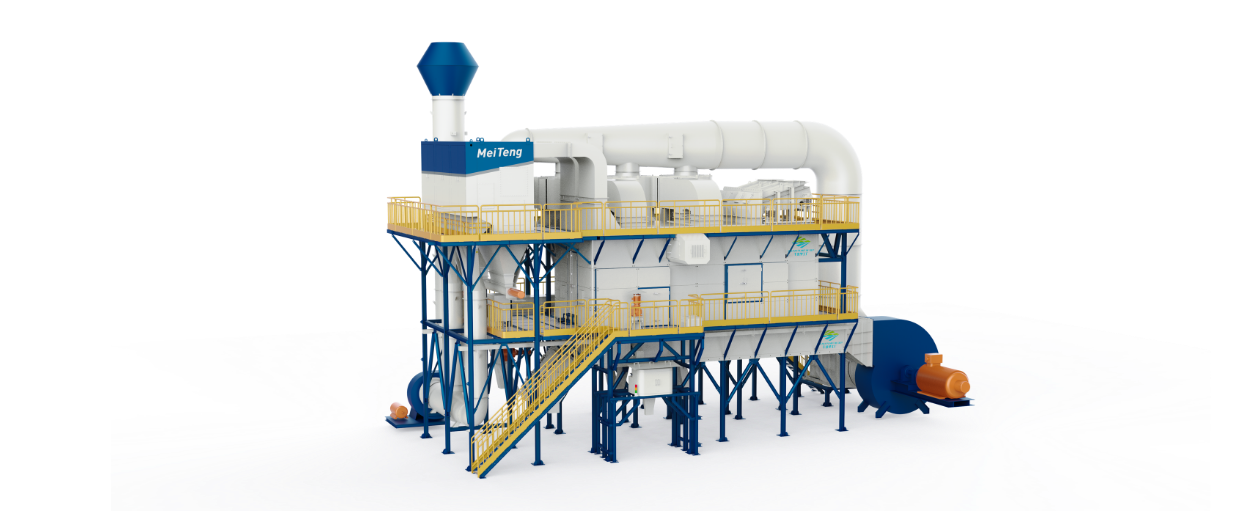
Leveraging continuous R&D investment, high-level patented technologies, and extensive large-scale industrial validation, TGS® combines innovation with reliability, enabling enterprises to achieve sustainable, low-cost dry separation of fine coal.
TGS® is based on the principle of gradient fluidization, designed for raw coal with a size below 80 mm. Fluidization allows solid particles to behave like a fluid under the effect of airflow. According to the difference of critical fluidization air velocity of materials with different densities, the TGS® arranges multiple exhaust chambers at the bottom of the separation bed, with the flow rate of each wind chamber controlled separately, creating multiple gradient force fields with different fluid apparent air velocities. Under the effect of fluid buoyancy and vibration force, particles of different densities and sizes are in different fluidization states in each gradient, achieving complete density stratification of particles through multi-gradient separation, and then accurately cutting out each layer of particles to achieve precise separation.
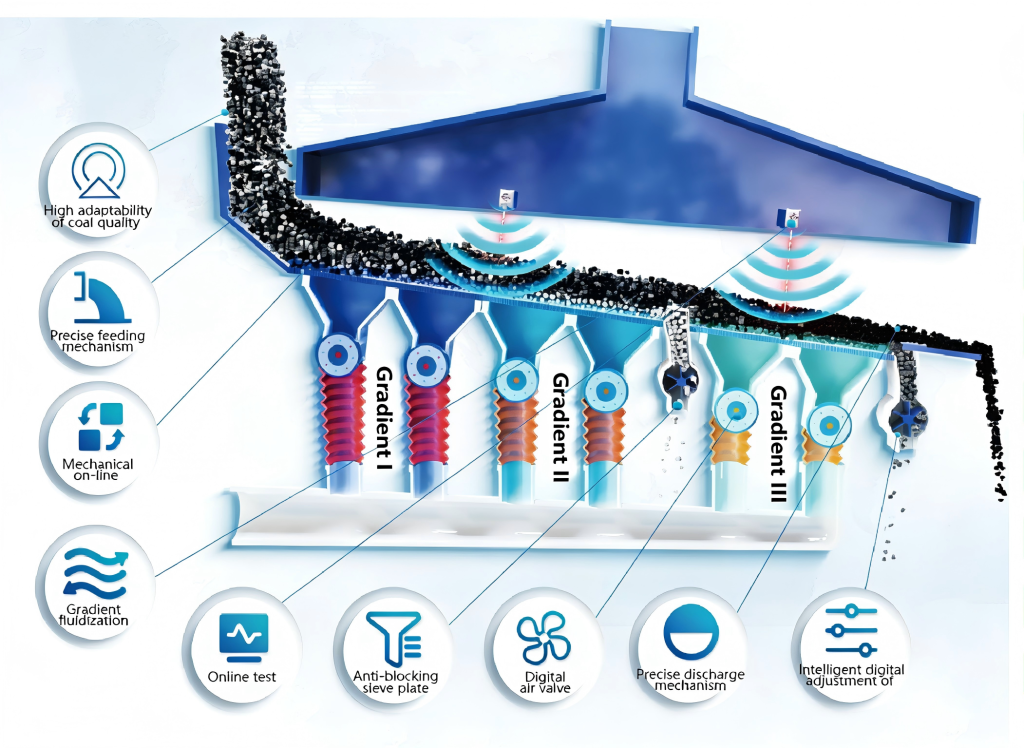
The TGS® system consists of an intelligent gradient-fluidization dry separation system, a digitally controlled air supply system, separation performance X-ray detectors and an intelligent density control system .
(1) The intelligent gradient-fluidization dry separation system is divided into different modules including the homogenisation feeding unit, power unit, separation unit, discharge unit and dust extraction unit.The operation of all module systems can achieve stable and accurate separation performance.
(2) The digital controlled air supply system is consisted of a low noise fan, digital air valve and air duct, providing separation power for the intelligent gradient-fluidization dry separation system, and to improve the separation performance and to achieve gradient fluidization separation.
(3) An automatic sampler and an X-ray separation performance detector are set up in the middlings or reject flows. The detection results are fed back to the intelligent density control system to guide the system adjustment.
(4) The intelligent density control system can receive data from the X-ray separation performance detector, bed state sensor, etc. The embedded controller carries an intelligent gradient fluidization density control model to adjust the separation density to achieve automatic operation . It is especially suitable for feeding conditions where the reject rate of raw coal is very low, very high or fluctuates greatly.
-
Coal quality upgrading
improving clean coal value while minimizing slime generation
Expand
-
Plant retrofitting and upgrading
enhancing efficiency and economic returns
Expand
-
Full particle-size dry separation
working in combination with TDS® for lump coal to create a comprehensive “dream plant” of dry coal preparation.
With proven performance in thermal coal, coking coal, and coal for chemical applications, TGS® provides a more sustainable, cost-effective, and intelligent alternative to traditional wet coal processing. It represents a new benchmark for modern coal preparation under diverse industrial conditions.
Expand
-
Highly Intelligent
AI-driven separation with digital control ensures stable performance and unmanned operation
-
Superior Separation Accuracy
Distinguishes coal and waste with high accuracy, even under complex conditions.
-
Large Processing Capacity
Capable of handling high-throughput operations with stable, continuous performance.
-
Wide Particle Size Range
Effectively processes multiple size fractions in one unit, reducing the need for multiple systems.
-
Higher Calorific Value
Produces clean coal with improved calorific value, maximizing resource utilization and economic benefits.
-
No Slime Generation
Dry process eliminates slime problems, improving product stability and simplifying downstream tailings disposal.
-
Lower Operating Costs
No water, magnetite, or chemicals consumption; reduced energy demand and maintenance costs.
| Model |
TGS 1050A |
TGS 2050A |
TGS 3050A |
TGS 4050A |
|---|---|---|---|---|
|
Feeding Particle Size (mm) |
Nominal Capacity (t/h)
|
|||
|
80-13/8 |
40-80 |
80-160 |
160-240 |
240-320 |
|
50-10/6 |
50-100 |
100-200 |
200-300 |
300-400 |
|
25-6/3 |
63-125 |
125-250 |
250-375 |
375-500 |
|
13-3/2 |
63-125 |
125-250 |
250-375 |
375-500 |
|
80-3/2 (Wide Size Range) |
/ |
105-210 |
210-310 |
310-420 |
Note:
- Processing capacity is related tothe feed size, moisture, washability and target coal products
- The final equipment selection can only be determined after calculation based on the customer’s raw coal washability data.
The separation accuracy of TGS® can reach that the misplacement rate of waste in coal is ≤3.0%, the misplacement rate of coal in waste is ≤5.0% or the waste discharge rate is ≥90%. These indicators are significantly superior to those of traditional air separation equipment.
The maximum processing capacity of a single TGS® unit can reach 600 t/h.
Independence on operator skills, experience, or responsibility, ensuring more stable separation performance. Reduce the number of operator in the system and lower the labor costs.
The system resolves the long-standing operational difficulties of conventional air jigs and air tables, by upgrading wind-based separation technology with integrating sensor-bas
Originating from MeiTeng’s in-house R&D, the technology is protected by +60 authorized patents ( include 1 international patents,10 invention patents, 48 utility model patents, and 1 software copyrights ).
Depending on customer needs, top tier motors, gear reducers, exciters, inverters, and electrical control components are used, significantly improving system reliability.
The complete unit has obtained CE, EAC, and GOST certifications, and can also be customized to meet specific requirements of different countries and users.
All material-contacting parts are equipped with wear-protection measures or wear-resistant liners. Consumable components such as screens, discharge wheels, and discharge chutes are designed for quick replacement.
The use of anti-blocking distribution plates thoroughly solved the problems of frequent clogging and difficult cleaning in traditional air tables.
The modular and skid-mounted structure reduces installation time and supports mobile plant construction needs.

 Phone: +86 189 2096 5107
  Email: overseasmarket@tjmeiteng.com
  Head office: Building A2, No.8, Saida 6th Branch, Economic and Technological


